 Free Newsletter
Cookware & Bakeware Alliance releases new guidance for non-stick coatings
Allison Zisko //Editor in Chief//June 4, 2026
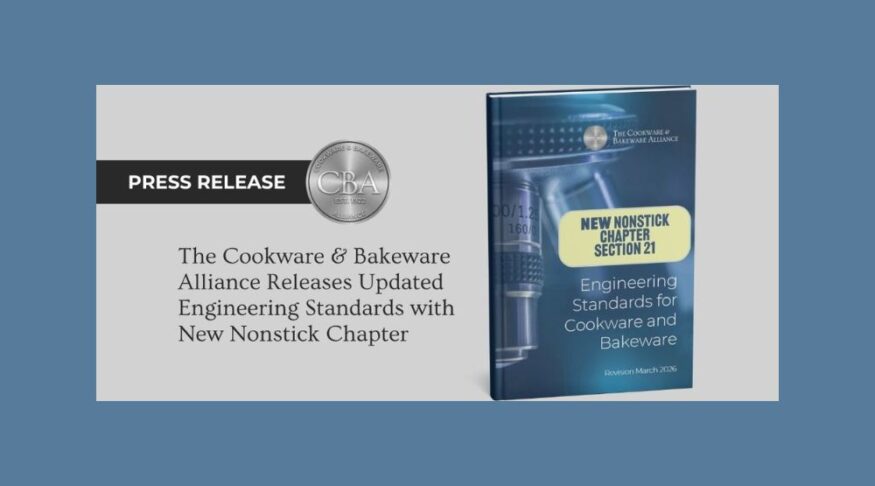
Image courtesy of the CBA
Cookware & Bakeware Alliance releases new guidance for non-stick coatings
Allison Zisko //Editor in Chief//June 4, 2026



The Cookware & Bakeware Alliance (CBA) has released an updated edition of its Engineering Standards for Cookware and Bakeware, the industry’s primary technical reference for product safety, performance testing and materials compliance.
The most significant addition to the 2026 edition is a dedicated, 32-page chapter on nonstick coatings, a topic that has grown in regulatory and consumer importance in recent years.
“The nonstick chapter arrives as the category faces heightened scrutiny from regulators and consumers alike, with federal and state-level legislation targeting PFAS and other chemical compounds associated with certain coating chemistries,” the CBA said in a release. “Having a standardized testing framework gives manufacturers and retailers a consistent benchmark for evaluating products and for demonstrating that products meet established safety criteria.”
The CBA is making the standalone chapter on non-stick coatings available as a separate purchase. The nonstick chapter can be downloaded as a PDF ($250) or obtained as a PDF plus printed copy ($350), giving companies the option to access that section without purchasing the full manual. More information is available here.
The Full Standards: 25 Sections Covering the Industry
Beyond the nonstick additions, the 2026 manual spans 25 sections covering the full range of cookware and bakeware materials and construction methods, from aluminum, stainless steel and cast iron to porcelain enamel, silicone, glass and clad materials. Sections address everything from handle and fitting specifications and metric sizing procedures to mechanical safety guidelines, induction compatibility, and organic thermoset exterior finishes.
The standards are developed and maintained by volunteer representatives from CBA member companies who serve on the Engineering Standards Committee and its subcommittees. The committee meets regularly to evaluate emerging materials, technologies, and regulatory developments and to update or create new standards accordingly.
CBA membership is open only to companies with substantial operations and headquarters in the United States, but the CBA noted that overseas factories supplying the U.S. market have equal reason to work from the same standards. “Compliance with U.S. safety and quality benchmarks has become a practical necessity, driven by consumer demand for transparency, and by an expanding body of state and federal product safety legislation,” it said.
Overseas factories can purchase the standards through the same non-member pricing structure available to any non-member organization.
Related Articles
Related Content
Contributor Content

How to identify the housewares gift that keeps on giving
A new Occasions Report form the IHA highlights opportunities[...]
December 20, 2022